 Building Information System
News
Recent News
Changes Proposed by the Ministry of Justice: Building Registration Costs to Fall by More Than 90% in Some Cases
Published Thursday, 24 September 2026Construction Process to Become More Flexible – Cabinet Approves “Zero Cycle” to Enable Earlier Start of Construction Works
Published Tuesday, 22 September 2026446 Violations Identified During Targeted Inspections in the Construction Sector
Published Tuesday, 22 September 2026Winners of “Latvia’s Most Energy-Efficient Building 2026” Competition Honoured
Published Friday, 18 September 2026MoE: Trust in Entrepreneurs and “Zero” Tolerance for Unnecessary Administrative Burden Are the Driving Forces Behind Construction Sector Development
 Published
Thursday, 18 June 2026
Published
Thursday, 18 June 2026
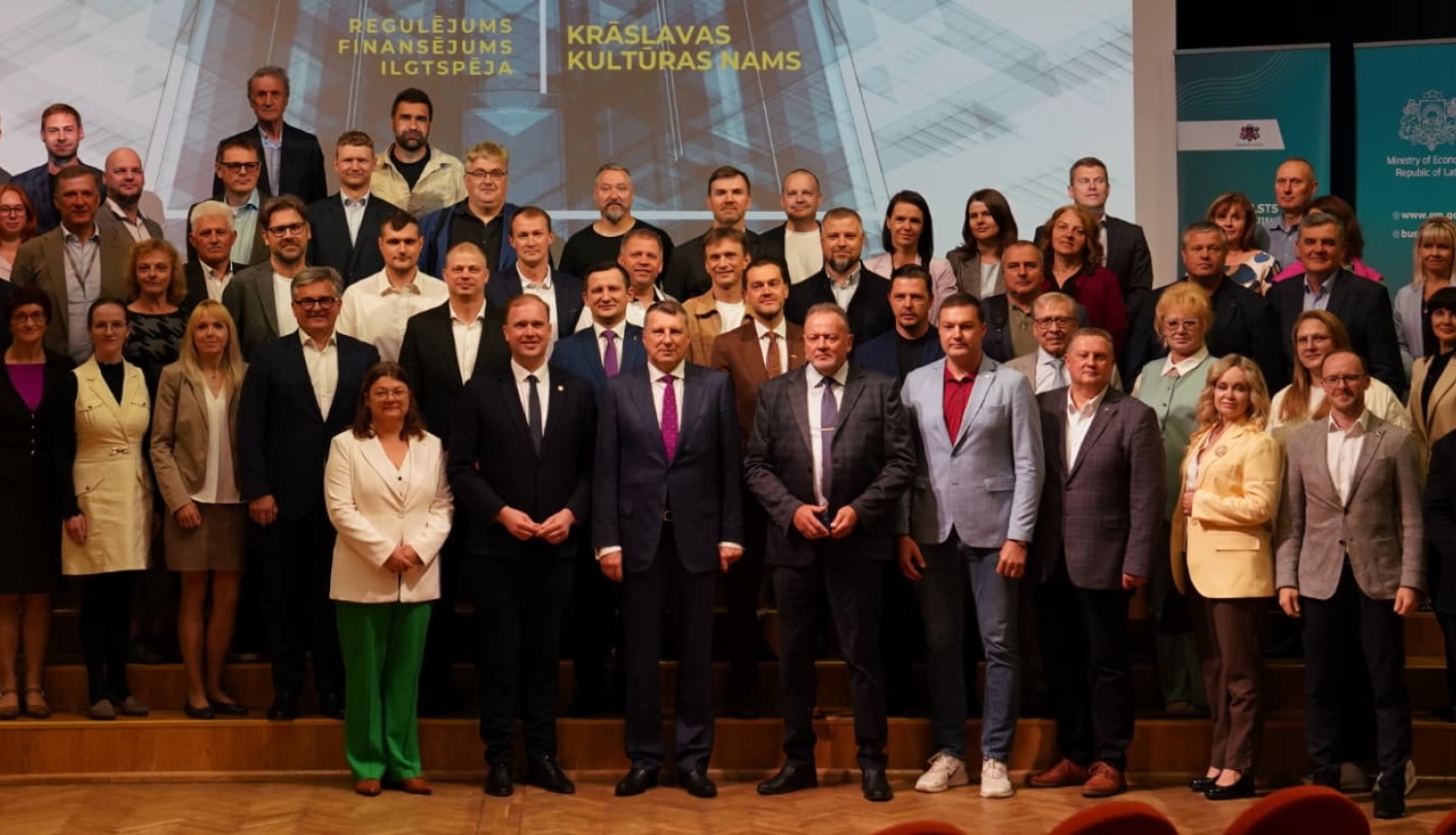
On 17 June 2026, the Construction Industry Conference “REGULATION | FINANCING | SUSTAINABILITY” took place in Krāslava. The event presented the Ministry of Economics’ (MoE) objectives for reducing administrative burden and attracting investment, alongside industry experts’ analysis of the challenges involved in implementing sustainable construction practices in Latvia.
The Ministry of Economics’ key objective in the construction and real estate development sector is a comprehensive “overhaul” of processes, introducing zero tolerance for unnecessary administrative burden. The government has approved an action plan comprising nearly 60 measures aimed at creating a fully digitalised and consistent construction process through the Construction Information System (BIS). According to data presented by the Ministry, these reforms are expected to reduce the time required for construction project approvals by approximately three months and generate around 5% savings in construction costs.
Minister of Economics Viktors Valainis stated:
“The choice of conference venue is no coincidence. It is a deliberate step towards decentralising decision-making and taking the industry beyond the Riga bubble. We must demonstrate through actions, not just words, that we are ready to support Latgale and other regions of Latvia during these challenging times. The construction sector is closely linked to overall economic development – when new residential buildings or factories are being built, it means economic growth. We have carried out significant work to simplify construction procedures. OECD experts have recognised that a few years ago Latvia ranked 56th in the world in terms of the complexity of obtaining a construction permit, whereas today it ranks second. In Riga we can already see the results, with construction sites appearing across the city at various stages of development. Our goal now is to create the same positive momentum in Latvia’s regions.”
Chairman of the Board of ALTUM, Reinis Bērziņš, noted:
“The fact that the construction industry conference is taking place in Krāslava sends a clear signal that all regions of Latvia are important. From our perspective, the regulatory changes implemented in recent years have created conditions that allow projects supported through ALTUM programmes to progress much faster. In the regions, low-rent housing projects have moved from concept to commissioning within a single year. ALTUM has no intention of stopping there, and we are particularly pleased that two significant projects – ‘Verems’ and ‘Avoti’ – have recently been completed in Latgale. Less than a month ago, we launched a new programme for businesses in border regions and have already received 20 applications.”
The latest shadow economy data also demonstrate improvements in sector efficiency. The construction industry has recorded the largest reduction in the shadow economy over the past five years, with its share falling to 29.5% in 2025. This supports the Ministry’s position that reducing bureaucracy and simplifying procedures are more effective tools for combating the shadow economy and improving the business environment than relying solely on stricter penalties.
The second part of the conference focused on sustainability practices. Edijs Kupčs, Head of the Latvian Construction Contractors Partnership (LBA), and Jānis Butkevičs, Sustainability Manager at Citrus Solutions, presented the results of an industry survey involving 125 construction companies.
The survey revealed uneven progress in sustainability across the sector. While medium-sized and large companies are already implementing CO₂ accounting systems and energy-efficiency data management, smaller companies still lack simple and practical solutions. The study concluded that the primary obstacles to introducing circular economy and sustainability solutions remain the dominance of the lowest-price criterion in public procurement, as well as insufficient understanding and a lack of clear guidance from contracting authorities.
LBA Chairman Edijs Kupčs commented:
“Sustainable construction begins with the client’s decisions, continues through industry cooperation, and ends with measurable results. The study clearly shows that, at present, businesses cannot justify the implementation of sustainability solutions from a commercial perspective when price remains the main evaluation criterion in procurement procedures. If sustainability is to become standard practice in the industry, we must strengthen ‘sustainable construction’ as a requirement at the regulatory level and actively reduce the dominance of the lowest-price principle in procurement, thereby creating a genuine competitive advantage for companies that adopt innovative approaches.”
An international perspective was provided by OECD economist Eness Sunel. In a video address, he praised Latvia’s progress in reducing administrative burden within the construction sector, while encouraging continued efforts to simplify regulatory requirements and permitting procedures.
Ministry of Economics of the Republic of Latvia
Public Relations Division
E-mail: san@em.gov.lv
Page refreshed on 2026-06-18


Change cookie preferences
|
State Construction Control Bureau
|
In case of reproduction of information, reference to the Building Information System is mandatory.
|
Build: 27116-C (20261015200112) (production)